Why Praxala Is One System, Not Six Tools
Before Praxala was a product, I worked in frustration for years: no platform did enough, so I stitched together a basket of tools - while the vendors never cared to close the gap. So I built the one I couldn't buy.
Why Praxala Is One System, Not Six Tools
Before Praxala was a product, it was a frustration I lived with for years.
My job was helping other organizations hit their sales and marketing goals, and to do it I had to go shopping - every single time. There was never one platform with enough out-of-the-box to actually run a strategy. So I'd buy a CRM here, an email marketing tool there, a social media calendar somewhere else, and spend my days stitching them into something that resembled a coherent system.
And half of what I stitched in was primitive. Email tools with bland templates - or templates so rigid that using one was more work than building my own from scratch. "Best of breed" sounds great until you're the one holding the needle and thread.
The gap nobody wanted to close
Here's the part that really got to me: the vendors didn't care.
I was a customer doing their product research for them - figuring out where their tool fell short, what I had to bolt on to make it usable, which combinations actually worked for a real business. Not once did an account rep circle back to ask what I ended up choosing, or whether it was working. You'd think a marketplace gap that big - enough sales and marketing capability, in one place, at a fair price - would be exactly the opportunity a vendor would chase.
They don't, because most of them wrote their core code well over a decade ago and have been riding those coattails ever since. The incentive isn't to close the gap. It's to keep you subscribed to the one piece they own and let you sort out the rest.
So you end up with the six-tool stack. And the problem was never any single tool - most of them do their one job fine. The problem is that you have six of them, and it was never anyone's job to make them one.
What the fragmentation actually costs
The six subscriptions are the part you can see. The expensive part is the part you can't:
- The same lead typed into three systems, a little differently each time.
- Sales and marketing looking at different numbers and arguing about which is right.
- The report that means exporting from five tools and reconciling it by hand on a Friday.
- Context that dies in the gaps - the note in the CRM the marketer never sees, the campaign result the rep never hears about.
Your team stops working like a team and starts working like fragmented departments talking to each other through paperwork. That's not something you can integrate your way out of. It's structural.
What I built instead
Praxala is the platform I couldn't buy.
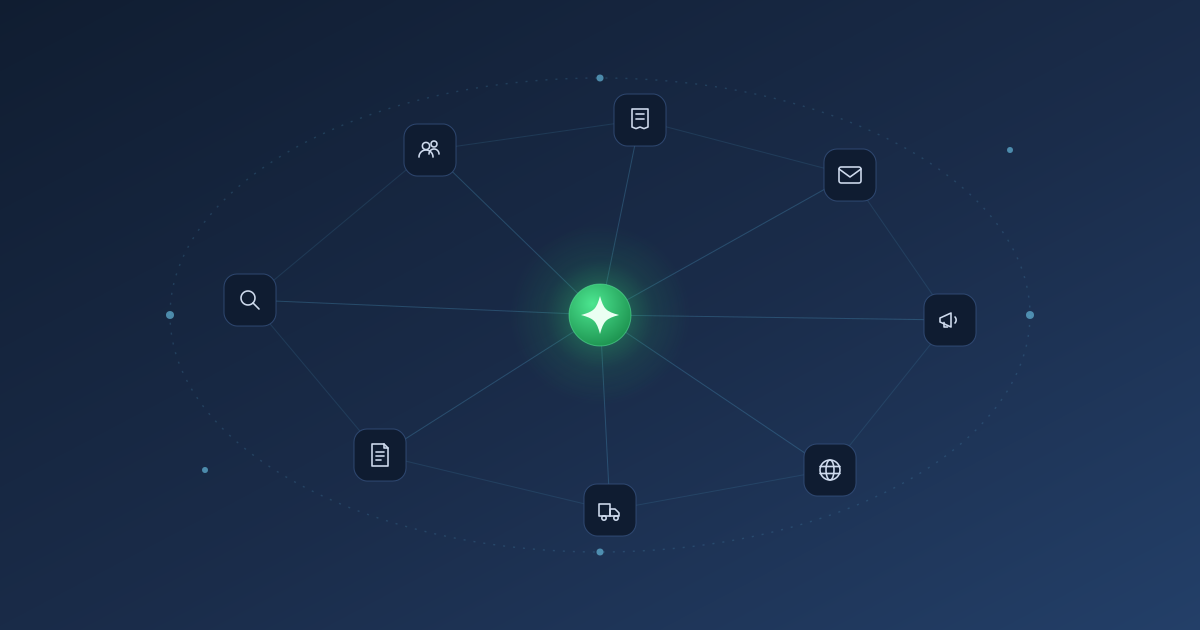
It pulls the whole sales-and-marketing motion into one system: CRM for sales and field service, quotes and estimates, invoicing, website and landing-page design and publishing, email marketing, social media planning, company and contact research, and document text extraction to kill the busywork - all under one cohesive AI layer that can actually see across the whole thing.
That last part is the point. When it's one system, sales feeds marketing and marketing drives the funnel - on their own, because they're working from the same record, not two exports of it. Nobody sits in a silo pulling numbers from a pile of tools to figure out what's working, why, and what to do next. The system already knows, because it *is* one system.
The honest trade-off
If you genuinely need the single most specialized tool in one category - the deepest email platform on the market, say - a unified system won't out-specialize a company that does only that one thing. That's a real trade-off, and I won't pretend it away.
But most businesses don't need the deepest tool in six categories. They need six good capabilities that actually talk to each other, at a price that doesn't require a finance meeting. That's the trade I'd make every time - and it's the one I built Praxala to offer.
The days of stitching a basket of tools together are over. One system. One record. One team, finally working as one.